
April 2026 Newsletter – Month of the Blue Water Dragon – Ren Chen 壬 ⾠
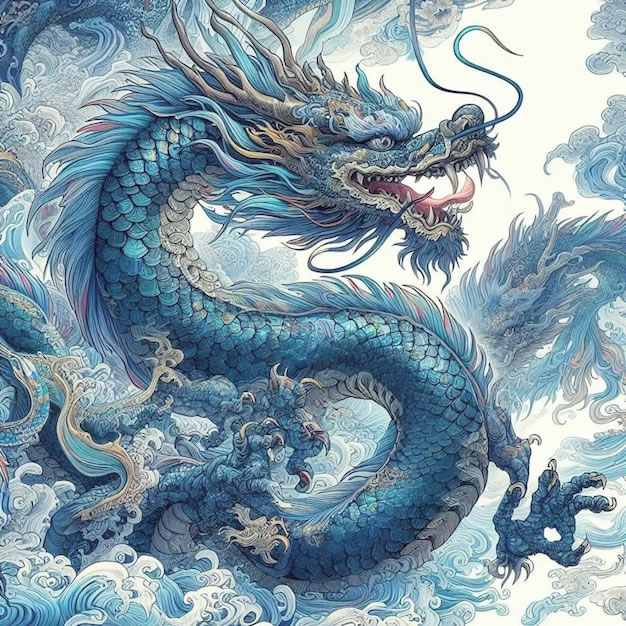
Special Chart to find the I Ching hexagram that rules your home or business!
– April 6 to May 5 –
This month is shaped by the energy of the Yang Water Dragon—a force that is powerful, commanding, and naturally draws attention. Dragons are known for bringing intensity, and this one adds a layer of heightened competition and quick, sometimes impulsive, action.
What makes this month especially dynamic is its interaction with the broader energy of the year: the Double Yang Fire Horse. Normally, Water keeps Fire in check, but this year’s Fire Horse energy is unusually strong. Instead of a smooth balance, we’re looking at more of a standoff—a clash rather than a calm. The result is a stretch of time marked by instability, rising tensions, and a sense of friction, both internally and in the world around us.
Given the larger global currents we’re already navigating, April invites us to focus less on controlling what’s unfolding and more on staying grounded amid the pressure. It’s a month for practicing steadiness—even when the ground beneath us feels unsteady.
This month, we’re turning to the I Ching—the ancient Chinese “Book of Changes”—for guidance. Using custom charts I created that link each hexagram to a home’s facing direction, you can discover the unique wisdom your own space holds for navigating the intensity of April.
The I Ching, often translated as the “Book of Changes,” is one of the oldest and most profound texts in Chinese civilization. Its origins stretch back over 3,000 years, beginning as a form of divination during the Zhou dynasty. The core of the system is built from eight simple three-line symbols called trigrams. Each trigram, made of solid (yang) or broken (yin) lines, represents a fundamental force of nature -such as Heaven, Earth, Water, Fire, Thunder, Wind, Mountain, and Lake. These eight trigrams were then combined in every possible pairing to create the 64 six-line symbols known as hexagrams, which form the heart of the I Ching.
For centuries, people would consult the book by casting yarrow stalks or coins to form a hexagram, then reading its accompanying text for guidance on how to navigate a situation. The structure of the I Ching is a beautiful representation of how change and cycles operate in the world. Each of the 64 hexagrams is more than just a symbol; it is a dynamic archetype, depicting a specific situation or stage in a process from creative beginnings (“Creative Force”) to quiet completion (“Before Completion”). The lines within each hexagram also move, offering a layer of nuance that shows how a situation is evolving.
The charts I’ve created below in English, connect the hexagrams to the compass direction your house faces, allowing you to tap into the I Ching’s deep association with space and the flow of energy through the environment, a principle central to Feng Shui. To use the charts for your home, just take a compass reading of the direction your home faces, (you can use your cell phone) – then find the degrees in the chart that match. The hexagram number corresponding to the degrees is the I Ching reading for your home.
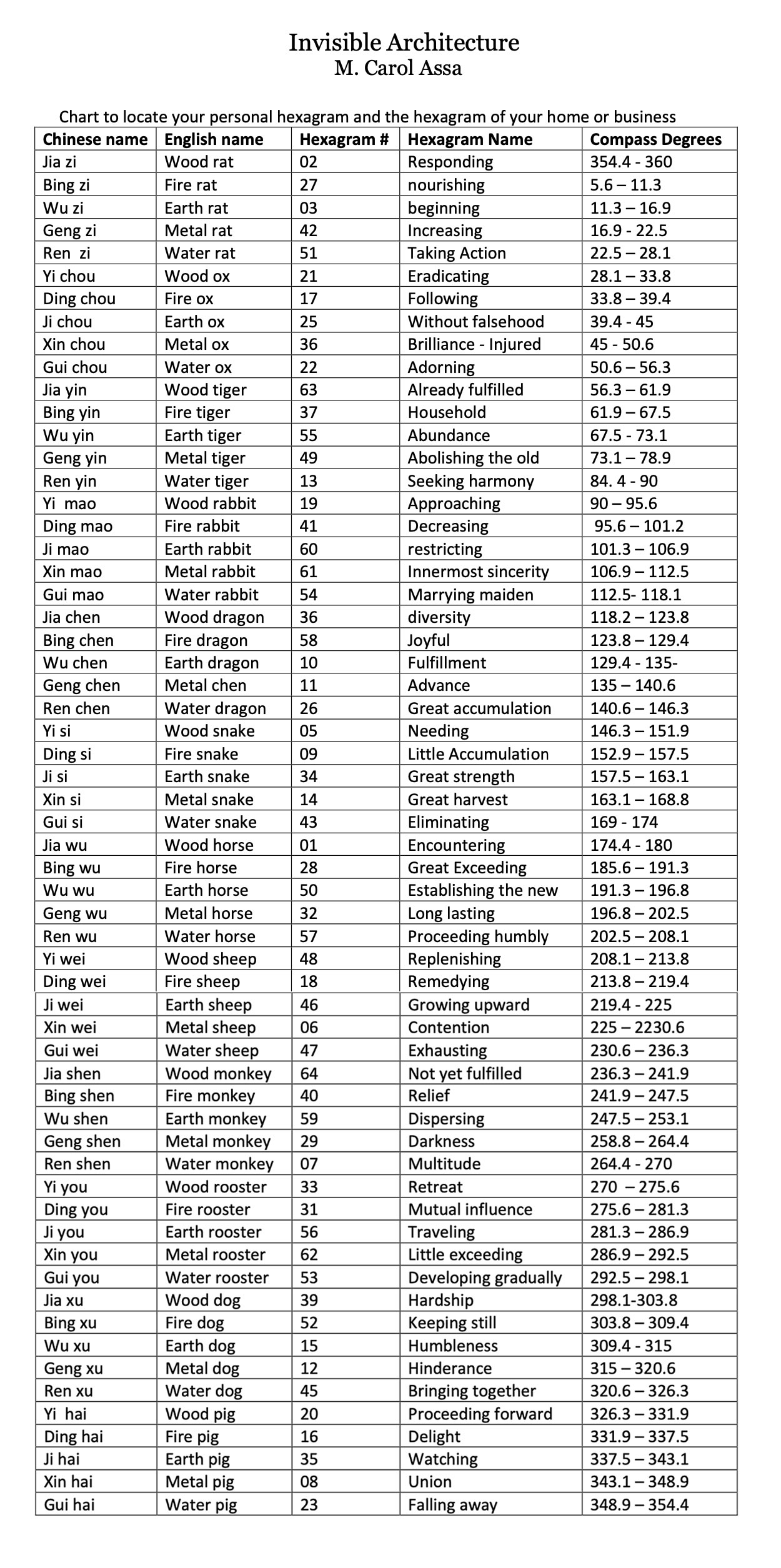
For example, if your home face 160 degrees, your I Ching hexagram is number 34 – Great Strength. Once you know the number you can go online, type \ hexagram 34 in search and you will get several sites to read further about the hexagram. Next month, I will show you how to find your personal I Ching number, and will provide a calculator to determine your birth animal and element.


